Introduction
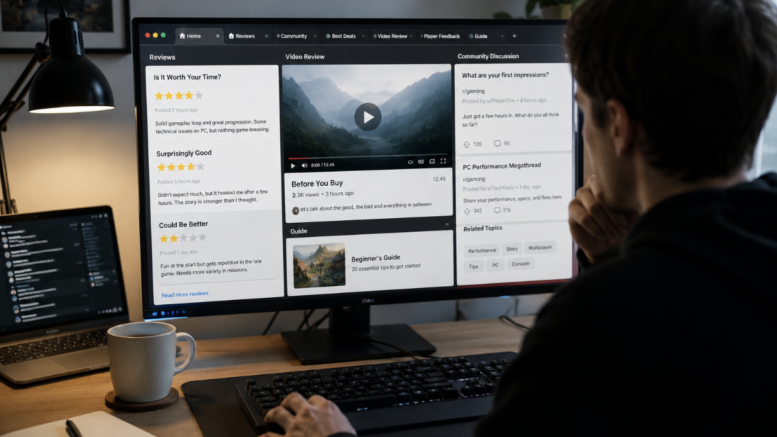
I have a bad habit of opening “just one more tab.” It happened again not long ago when I was thinking about trying a new streaming service.
I checked one review, then another. Ended up on Reddit. Opened a comparison site. Somehow I found myself back on the official website because I couldn’t remember whether one feature was actually included.
Twenty minutes later I laughed at myself. I’d followed exactly the same routine I use before buying almost every game these days.
Gaming has this strange effect on people. After enough disappointing launches and overhyped releases, you stop taking the first thing you see at face value. You get into the habit of looking around first. Eventually, that habit follows you everywhere.
Hype Doesn’t Fool You Forever
Remember when pre-ordering games felt exciting? For a lot of us, that excitement disappeared after one or two disappointing launches. A trailer can look amazing.
A gameplay demo can be carefully edited. Marketing can make almost any game feel like the next big thing. Then release day rolls around, and the conversation changes completely. Suddenly everyone is talking about stuttering, broken quests, balance problems, or features that quietly disappeared somewhere between the trailers and launch.
After you’ve seen that happen a few times, waiting a day or two for real player feedback stops feeling like patience. It just feels like common sense.
Waiting for honest feedback starts feeling much smarter than rushing to be first.
Players Notice Things Marketing Never Will
Professional reviews are useful, but I usually end up reading player comments anyway. Not because I expect them to agree with each other. Quite the opposite. One person complains about the combat.
Another says it’s the best part of the game. Someone else points out a bug that only appears twenty hours in. I don’t read community discussions because I expect everyone to agree. They never do.
I read them because, somewhere between the arguments, memes, and wildly different opinions, a clearer picture starts to emerge. You learn what keeps coming up, what people are willing to forgive, and what keeps frustrating them hours into the game.
That’s the kind of information you rarely get from a score out of ten.
I Started Comparing Everything the Same Way
Somewhere along the way I stopped doing this only with games.
The same routine now happens when I’m choosing software, buying a keyboard or paying for another subscription.
Online casinos aren’t really any different.
The homepage always highlights the biggest selling points. What I usually want to know comes afterwards. How easy are withdrawals? Which payment methods are supported? Are there conditions that only become obvious after you’ve already signed up?
That’s where comparison websites save a lot of time.
CasinosAnalyzer isn’t a casino trying to convince people to join. It’s a comparison platform that reviews licensed operators, explains bonus conditions, compares payment methods and helps Australian players understand the differences between offers before opening an account.
The Small Print Is Usually Where the Real Story Starts
I’ve made enough impulse purchases over the years to know that the flashy headline is usually the least important part. Whether it’s a new game or a casino promotion, the questions always come afterwards. What’s the catch? Are there restrictions? Does it actually work the way it sounds?
That’s one reason Australian players often read the Royal Reels bonus overview from Australian CasinosAnalyzer before signing up. Instead of piecing the information together themselves, they can quickly see how the welcome offer works, who qualifies, what wagering is involved, and which terms deserve a closer look.
It isn’t very exciting research, but neither is requesting a refund because you skipped the small print.
Maybe That’s the Real Skill Gaming Teaches
People often talk about faster reflexes or better problem-solving. Those are nice. The habit I’ve found most useful is much simpler.
Gaming teaches you not to rush. It’s a habit that’s followed me outside gaming.
I’ve lost count of how many times five extra minutes of reading changed my mind completely. Sometimes it convinced me to go ahead. Other times it saved me from making a purchase I’d probably regret. Either way, it was time well spent.
Conclusion
The internet isn’t short on options. If anything, there are too many. That’s exactly why slowing down has become surprisingly valuable. Read a couple of reviews.
See what real users are saying. Open one more tab before clicking “Continue.” It won’t guarantee you’ll always make the perfect choice.
But you’ll probably make fewer bad ones.



Be the first to comment on "The Hidden Gaming Habit That Follows Us Across the Internet"