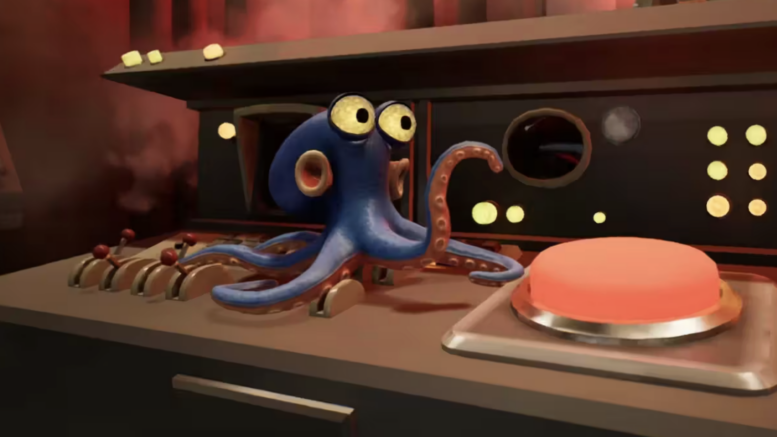
There is a particular kind of indie game that does not announce itself loudly. No massive marketing campaign, no recognizable franchise, no pre-launch hype cycle. It just arrives, asks for a few hours of your time, and quietly delivers something more memorable than titles that cost twenty times as much to make. Darwin’s Paradox! is that kind of game.
Built around a small, surprisingly expressive octopus navigating a factory full of rats, robots, and alien conspirators, it manages to be charming, inventive, and genuinely challenging — sometimes all within the same level. It captures the same sense of unexpected discovery you might get from stumbling across something valuable without much buildup, not unlike finding a hidden perk such as EliteSpin Casino offers, tucked away where you least expect it. This is the kind of game you start on a Tuesday evening expecting to play for an hour and finish three sessions later, slightly surprised by how much you cared about a cephalopod you cannot even name.
The Setup
The story begins in the ocean. Our unnamed octopus protagonist and his friend Darwin are living the kind of carefree underwater life that exists only in animated films and game prologues — exploring, getting into scrapes, and gradually learning a set of abilities: clinging to surfaces, accelerating underwater, dragging objects, deploying ink screens against enemies, camouflaging against backgrounds. It is a gentle, well-paced introduction that does important work before the plot kicks in: it makes you actually like this small creature.
Then things go wrong, and they go wrong quickly. Both octopuses are abducted — not by a fisherman or a research vessel, but by aliens, who deposit them in a canning factory with evident culinary intentions. The protagonist escapes. Darwin does not. What follows is a rescue mission that takes our hero from rubbish tips through sewers, factory floors, laboratories, and corporate offices, unraveling an evil corporation’s plan to enslave the world with extraterrestrial assistance along the way.
The tone throughout sits comfortably in Pixar territory: warm, occasionally melancholy, consistently funny, with just enough genuine stakes to keep the emotional thread taut. The corporation’s scheme is appropriately absurd. The supporting cast — including some memorably unusual office staff encountered in the later levels — is sketched with enough personality to raise a smile. The story is not going to linger with you for weeks, but it earns its ending, and that is more than a lot of games can say.
The Mechanics
Darwin’s Paradox! makes a design choice that initially feels like a drawback but reveals itself as a genuine strength: the protagonist begins the game having apparently forgotten everything learned in the prologue. Abilities are reacquired gradually as the adventure progresses. This means the game introduces its mechanics at a pace that allows each one to land properly before the next layer of complexity arrives — rather than front-loading a tutorial and hoping you remember it an hour later.
Early levels work primarily with the cling-and-push toolkit. The octopus can attach to almost any surface — walls, ceilings, pipes — and drag objects to solve environmental puzzles. Then the sewers arrive and introduce one of the game’s most memorable early challenges: Darwin must submerge in luminescent waste to glow in the dark and frighten off the rats patrolling the corridors. The glow fades over time, requiring quick movement between glowing sources — while also managing the fact that the slime degrades the suction cups, meaning the hero must periodically find clean water to restore his climbing ability.
It is a simple system on paper, but the way its components interact creates puzzles that feel genuinely satisfying to work out. Nothing is handed to you. Everything makes sense once you solve it. That is a harder balance to strike than it sounds.
As the game progresses and more abilities unlock, the puzzle design becomes richer accordingly. Camouflage introduces stealth sequences in which Darwin must move carefully through areas patrolled by watchful robots, timing movements to stay out of sightlines. The ink screen returns as a tactical tool against enemies that cannot be outrun. Later levels borrow freely from classic stealth game vocabulary — hiding in ventilation shafts, using noise to distract guards, moving between cover points. If some of this sounds familiar to anyone who has spent time with Metal Gear Solid, that is not a coincidence. Darwin’s Paradox! is published by Konami, and the Easter eggs scattered throughout feel less like winking references and more like earned inheritance.
The Difficulty Curve
For most of its runtime, Darwin’s Paradox! strikes a difficulty balance that is genuinely well-calibrated. Puzzles require thought without becoming frustrating. Stealth sections demand patience without feeling arbitrary. The game respects the player’s intelligence enough to present a real challenge without over-explaining its solutions, and the moderate difficulty of most levels creates a pleasant rhythm: stop, survey the situation, form a plan, execute it imperfectly, adjust, succeed.
Towards the final third, though, the game’s confidence in its own design occasionally tips into something less forgiving. Timing requirements become strict enough that certain sequences must effectively be memorised rather than solved. The correct path is identifiable — you can see exactly what you need to do — but executing it within the available window demands a precision that sits at odds with the more cerebral tone of the earlier levels.
The octopus’s tendency to cling to every available surface, genuinely useful in most contexts, becomes a liability in fast-moving sections where attaching to the wrong wall at the wrong moment means starting over. This is a mechanic that works brilliantly when you have time to think and becomes a source of quiet profanity when you do not.
The autosave system compounds this. Checkpoints are spaced generously in some areas and frustratingly sparsely in others. A mistimed jump or an unexpected enemy detection can send the player back through a substantial portion of a level. This is not unusual for the genre, but it stings more acutely in sequences where the difficulty comes from execution rather than problem-solving. Having to repeat long stretches because of a clumsy platform moment after you have already figured out the puzzle is the game’s most consistent source of frustration, and it is the one area where a little more generosity would have made a meaningfully better experience.
The Presentation
Whatever reservations one might have about the difficulty spikes, Darwin’s Paradox! is an unqualified visual success. Its locations are rich and characterful — grimy sewers giving way to the organised chaos of the factory floor, which gives way to the sterile corridors of corporate laboratories. Each environment has its own color palette and visual identity, and moving between them feels like genuine progression rather than a reskin.
The backgrounds are consistently alive with incidental detail. As the game progresses, the slow accumulation of Darwin’s actions begins to show in the environment — the factory gradually descending into chaos behind him, the world bearing the marks of his passing. It is the kind of environmental storytelling that rewards players who pay attention.
The character animation deserves particular attention. The protagonist moves with a physicality that is immediately convincing: the way tentacles respond differently to different surfaces, the subtle expressiveness in movement that communicates emotion without the need for facial features. It is exactly the kind of animation work that is easy to take for granted because it is so effective — you only notice it if you stop to think about how much harder the game would be to care about if it were not there.
The Verdict
Darwin’s Paradox! is a small game that knows exactly what it wants to be and executes that vision with skill and evident affection. Its puzzles are inventive. Its world is beautiful. Its story is warm and occasionally surprising. The mechanical variety — calm exploration alongside tense, ability-juggling chases — keeps the experience feeling fresh across its runtime in a way that many larger games fail to manage.
The difficulty spikes in the final act are real, and the occasionally cruel checkpoint spacing is a genuine irritant. But these are the frustrations of a game ambitious enough to push its mechanics to their limits, not of one that has run out of ideas. The difference matters.
For anyone with a fondness for puzzle-platformers, a tolerance for moderate difficulty, and a soft spot for stories about small creatures with big hearts taking on enormous problems, Darwin’s Paradox! is well worth a session or two. It is the kind of game that reminds you why the genre exists — and why the best entries in it can punch so far above their apparent weight.
Darwin’s Paradox! is available now. Published by Konami.