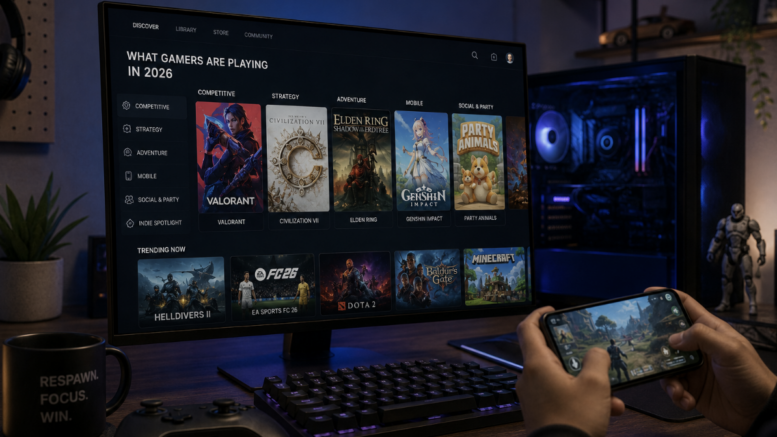
Gaming in 2026 is less a contest between platforms than a rotation between moods. The Entertainment Software Association reports that 212.3 million Americans play video games and 67% play for at least an hour a week. Mobile reaches every age group most widely, yet PC and console remain especially common among younger generations. Those numbers explain a week that can hold a ten-minute phone puzzle, a demanding strategy campaign and a late-night squad match without contradiction.
Players are not choosing one permanent identity. They are choosing the amount of attention, cooperation and commitment they have available at that moment. The most revealing trends therefore sit between genres: old competitive games keep enormous communities, strategy has become easier to resume, and mobile adventures borrow systems once reserved for dedicated hardware.
The old giants still own the lobby
Steam’s live chart in August 2026 still placed Counter-Strike 2, Dota 2 and PUBG: Battlegrounds at the top. Their staying power comes from readable rules paired with nearly endless human variation. A map can be familiar for years and still produce a new tactical problem because another team changes the timing.
Free entry also keeps the door open. Regular updates, spectator culture and established friend groups give these games a social cost to leaving, even when a player samples several newer releases.
Age matters less than cadence here. A veteran title can feel current when patches change maps, heroes or weapons often enough to restart the conversation without erasing learned skill.
Twenty minutes, one decision: strategy on a Tuesday
Hearts of Iron IV, Crusader Kings III, RimWorld and Factorio all appeared in Steam’s most-played list during the August check. None is a quick reflex game. Their presence shows that deep systems still attract large audiences, especially when saves, pause controls and clear session goals let players return without starting over.
The modern strategy habit is modular. One evening may cover a single production bottleneck; another, a diplomatic crisis. Depth survives because the player controls the stopping point.
Creators have also improved the return path. Tooltips, searchable logs and community-made guides reduce the penalty for forgetting a system during a week away.
Mobile adventures became the default gateway
ESA’s 2026 figures put mobile play at 80% across age groups, ahead of every other device category. Puzzle games lead on mobile, while action, shooter and arcade titles have stronger shares on console. The phone therefore serves both the broadest entry point and the fastest laboratory for hybrid design.
Adventure games now adopt daily tasks, social events and short chapters that respect a commute-sized session. The best ones preserve a sense of place without demanding that every visit last an hour.
Hardware helps. Faster phones, cloud saves and controller support let one account move from a pocket screen to a larger display, while age ratings and spending controls remain essential checks.
Sports markets borrow a game-like rhythm
Live sports products use familiar interaction patterns: changing numbers, compact dashboards and immediate feedback. The resemblance can make a betting screen feel like another game interface, even though money and financial risk create a different category of decision. A player viewing ipl in bet markets should read the odds as prices, set a fixed entertainment budget and avoid chasing a result after the match changes. No streak, animation or statistical model guarantees a return, and only adults who meet local rules should participate.
Players assemble portfolios, not tribes
The same Steam chart can hold a military simulation, a football management title, a farming game, a social sandbox and a tactical shooter. That mix is the point. Subscription libraries, cross-progression and persistent accounts make it easier to keep several games active without treating each purchase as a permanent allegiance.
Time now organizes the portfolio. Competitive games claim focused blocks, mobile titles fill gaps, and long-form adventures wait for weekends. Genre labels matter less than the job a game performs in a player’s day.
Cost shapes the mix too. A free competitive staple can sit beside one carefully chosen premium release and a subscription catalogue, spreading both expense and attention across the month.
Apply the same safety screen to every service
A trustworthy play routine starts before the first tap: check age ratings, permissions, spending controls and the source of any download. Betting services require an extra layer – local eligibility, identity checks, payment rules, withdrawal terms and self-limit tools. A page carrying the name Mel Bet should receive the same scrutiny as any other account that handles personal or payment data. Use unique credentials, review transaction records and never treat a commercial brand name as proof of guaranteed winnings.
Controlled variety is the lasting trend
The standout habit of 2026 is not one genre winning. It is players moving between established competitive worlds, patient strategy and portable adventures with less friction. A healthy rotation keeps the purpose clear: competition, concentration, connection or simple rest.
Pick games that fit the available time, then use platform controls to protect that boundary. Variety feels better when the player – not a notification schedule – decides when the next session begins.
The smartest library is not the largest. It is the one whose active games still earn their place when time, privacy settings and recurring costs are reviewed.




Be the first to comment on "The 2026 Game Shelf Has No Single Center"