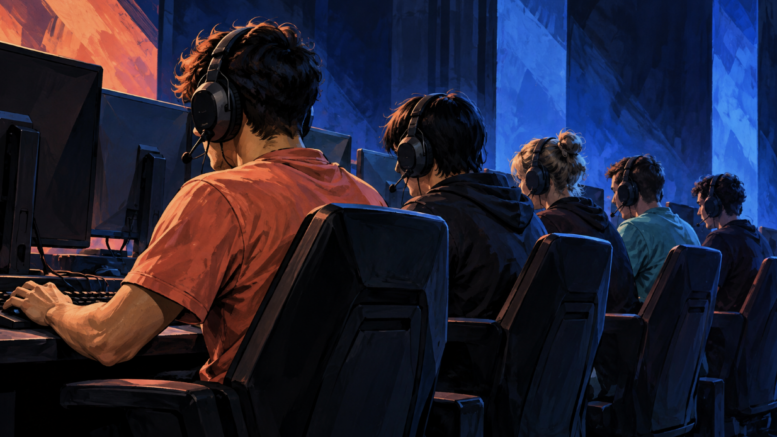
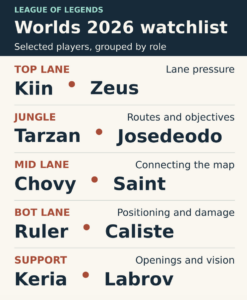
Gen.G enter Worlds 2026 as champions of the LCK, South Korea’s leading League of Legends competition. Following a tournament through individual players brings different parts of each match into focus: a lane advantage, an approach to an objective, or the opening that starts a fight. Ten selections across all five positions make room for that range, with two players representing each role.
The same scoreboard cannot explain every position equally. A marksman’s damage, a top laner’s pressure, and a support’s timing describe different contributions. Career history adds another distinction: a returning champion, an established contender, and a Worlds newcomer arrive with different records behind them, even when they play the same role.
Player backgrounds help separate an established reputation from a developing career. Reading profiles of the top LoL players alongside recent results brings career history and current form together.
Top lane: Kiin and Zeus
Gen.G’s Kiin stands out for consistency in DPM Esports’ pre-tournament team assessment. Its October 14 season snapshot records an average lane lead of 315 gold at 15 minutes. The measure compares his gold with his lane opponent’s at a fixed point, capturing an advantage that a kill count alone can miss. Farming, the collection of gold from minions, contributes to that lead. It describes his 2026 laning, rather than results from the current Worlds.
Hanwha Life Esports’ Zeus brings championship experience from T1. DPM emphasizes his willingness to use less conventional champion choices. That gives his games a different point of interest: the selection itself, followed by how it functions in lane. Champion choice changes the tools available, including reach, mobility, and ways to start an engagement. Following those tools makes a distinctive pick understandable beyond its novelty. DPM’s October 14 season snapshot lists Gnar as his most-played champion, with 18 games. His repertoire includes regular selections alongside those less conventional picks.
Jungle: Tarzan and Josedeodo
Tarzan enters with China’s LPL champions Anyone’s Legend. DPM’s account centers on his routes through the jungle and preparation around objectives. Objectives such as dragons draw several players toward the same area, making the approach part of the contest. A jungler’s contribution begins before the final hit: movement, nearby teammates, and access to the surrounding ground all shape the action. Tarzan offers a way to follow that preparation, rather than concentrating solely on the capture.
Team Liquid’s Josedeodo brings a contrasting emphasis. DPM highlights his mechanics on Lee Sin and Qiyana within a roster coming off the North American LCS Summer title. Mechanical execution concerns how precisely a player uses a champion’s abilities and movement. In jungle, that execution sits alongside decisions about where to intervene. Following Josedeodo connects the individual action to the wider map, without treating a successful play as the work of one person alone.
Mid lane: Chovy and Saint
Gen.G’s Chovy arrives with another LCK title while still seeking his first Worlds championship, as Sheep Esports explains in its midlane player profiles. His domestic record gives the tournament a historical thread. Within each game, mid lane’s central position supplies an immediate focus. Movement away from the lane can connect a midlaner to either side of the map, bringing lane resources, timing, and participation in fights into the same performance.
Saint’s first Worlds appearance follows LYON’s top-three Mid-Season Invitational (MSI) finish. Sheep points to his MSI performances against Caps and Zeka as evidence of his development. Those encounters give his debut context: he has already faced established international midlaners. Chovy’s longer pursuit and Saint’s first appearance put different career histories behind the same position.
Bot lane: Ruler and Caliste
Ruler’s season with Gen.G improved before he earned LCK Finals MVP, according to DPM’s assessment. His finish to the season provides a more immediate reference point than his reputation. For a marksman, the ranged damage dealer usually played in bot lane, positioning and sustained damage belong together. The space around a fight affects how long that damage can continue, so his contribution is visible in movement between attacks, as well as in the eventual damage dealt.
Caliste is playing his first Worlds with Karmine Corp. DPM identifies his partnership with Busio as an important part of his teamfighting. Bot lane makes the relationship between individual execution and shared space especially visible: the carry’s attacks sit alongside another player’s protection, pressure, and initiation. Caliste’s first appearance offers a new career milestone, while the partnership gives his games a point of focus.
Support: Keria and Labrov
T1’s Keria draws DPM’s attention for creative champion selections. Its October 14 season snapshot lists 14 games on Bard and 13 on Camille. These recurring selections give his draft a history within the 2026 season, alongside the immediate contribution each champion makes to the team during a game. Draft, the champion selection and banning phase, introduces that side of his contribution before play begins. The choice establishes the tools he brings to starting fights, protecting teammates, and moving around the map.
Labrov’s partnership with G2’s jungler is another strength identified by DPM. Their coordination brings support play beyond the bot lane into view. Vision control concerns which parts of the map each team can see, with wards and abilities helping reveal movement through otherwise hidden areas. Movement between areas, control of vision, and arriving together connect the support’s contribution to decisions elsewhere on the map. The support’s position, and which teammate moves with him, give a fuller account of his involvement than his own kill total.



Be the first to comment on "10 players to watch at Worlds 2026, with standouts in every role"