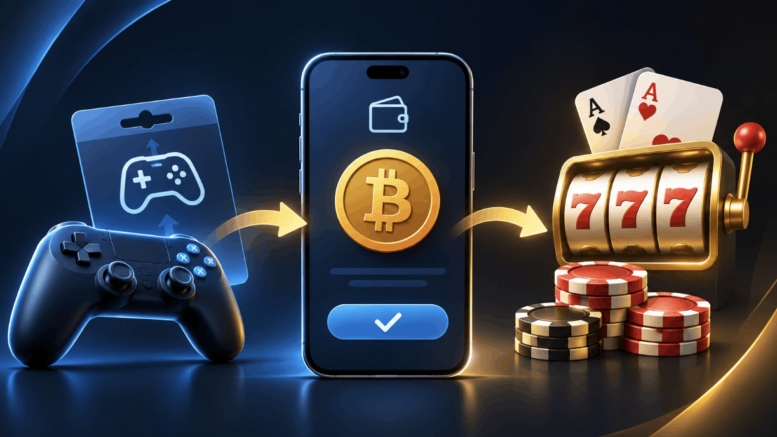
In April 2016, Steam started accepting bitcoin. By December 2017 it had stopped, and Valve gave two reasons: network fees that had climbed from about 20 cents to close to $20 per transaction, and price swings big enough to change what a game cost between checkout and confirmation. Almost a decade later, Steam still does not take crypto, and neither do the app stores where most mobile players buy crystals, gold and passes.
Online casinos moved in the opposite direction, and many now run entirely on crypto, with deposits and withdrawals that move in minutes. For a player who holds a little USDT or bitcoin, that creates two very different experiences, and the gap between them says a lot about where crypto payments actually work.
Where crypto works directly, and where it does not
Game publishers sell through Apple, Google, Steam or their own web stores, and none of the big ones accept crypto at checkout. Crypto casinos are built the opposite way: the cashier gives you a wallet address, you send coins, and the balance appears once the network confirms the transfer. Withdrawals go back the same way, straight to a wallet you control.
For players in the United States, that difference matters more than almost anywhere else. Real-money online casinos are licensed in only a handful of states, and the 2006 Unlawful Internet Gambling Enforcement Act pushes US banks and card processors to block payments to unlicensed gambling sites, so a card deposit to an offshore casino often simply fails. Crypto skips the bank in the middle, which is a big part of why so many American players who already hold bitcoin or USDT end up at crypto casinos rather than card-based ones.
The same setup lets those casinos offer US players a free test run before they spend anything. Several offshore crypto casinos still hand out free spins or small free chips on signup, and a crypto casino no deposit bonus is the cleanest way for an American player to check a cashier before sending real coins. The value is small, typically capped at $100 to $200 in winnings with wagering attached, but it shows whether the site actually pays out before any money leaves your wallet. These operators are open to US players aged 21 and over, sit outside state regulation, and some exclude particular states, so it is worth reading each site’s terms for where you live before signing up.
Game stores have nothing comparable. The closest thing is a free daily reward, and those are designed to bring you back each day rather than to show you how payments work.
Topping up a game with crypto
Since games will not take coins directly, crypto players use a workaround: digital gift cards. Services such as Bitrefill sell Steam, PlayStation, Xbox, Nintendo, Google Play and App Store cards for bitcoin, USDT and other coins, and the code arrives by email once the payment confirms. Redeem it in the store, and the balance works like any other top-up.
Two details trip people up. Gift cards are region-locked, so a US account needs a US card, and a mismatch usually cannot be refunded. The card also only gets you store credit, which you then spend on the game currency itself, so it pays to know what you are buying before you convert. Players working through the Blox Fruits shop, for example, are better off deciding between a fruit and a game pass before buying the Robux, not after.
Some mobile games now add a third route. Star Wars: Galaxy of Heroes has run a global web store since 2022, where crystals and bundles are bought with real money through EA instead of the app store. It requires an EA account linked to the game, and EA’s own instructions for the SWGoH Web Store note that it is not available to players under 18. It still does not accept crypto, so a crypto holder would need to convert to dollars first.
The network matters more than the coin
Whether the coins go to a gift card shop or a casino, the costliest mistakes usually happen at the network step. USDT, for example, exists on several blockchains, including Tron (TRC-20) and Ethereum (ERC-20). Tron transfers usually cost well under a dollar, while Ethereum fees can be several dollars when the network is busy, which matters a lot on a $20 top-up.
Whatever you buy, the network in your wallet must match the one the cashier or gift card shop shows. Send USDT on the wrong chain and the funds may never arrive. Bitcoin has the same problem in a different form: on-chain transfers can be slow and costly when the network is busy, which is exactly what pushed Steam away in 2017, while services that support the Lightning Network can settle small payments almost instantly for a tiny fee.
One-way money versus two-way money
Crystals, gems and V-Bucks are one-way money. Once you buy them, they stay in the game, and the only thing they can turn into is more game content. A casino balance works in both directions, because whatever is left can be withdrawn back to your wallet.
That makes casino deposits feel more flexible, but it also changes the risk. A game top-up has a fixed cost, and you know exactly what you get for it. A casino deposit can grow or disappear depending on results, and the odds behind each spin follow the same random number logic that drives game reward systems, as the comparison of loot boxes and slots showed. Two-way money is only useful if you actually use the way out, which means withdrawing winnings instead of leaving them on the site.
How the three routes compare
| Gift card for a game | Game web store | Crypto casino deposit | |
|---|---|---|---|
| Pay with crypto directly | Yes, through the gift card seller | No | Yes |
| Money can come back out | No | No | Yes, by withdrawal |
| Main risk | Wrong region or card value | Delivery problems with bundles | Losing the deposit while playing |
| Free trial possible | No | No | Sometimes, through no deposit offers |
Before you send anything
A few checks cover most problems, whether the coins are heading to a gift card shop or a casino cashier:
- Match the network in your wallet to the one the receiving site shows, and send a small test amount the first time.
- Check the region on any gift card against your game account.
- Time game purchases around the events in the SWGoH events calendar so crystals go into the content you actually want.
- Set a casino budget before depositing, and treat it as money spent, not money stored.
- Withdraw winnings as soon as they clear, especially small ones from free offers.
Crypto is still awkward for buying games and convenient for casinos, and that is unlikely to change soon. Knowing which route you are on, and which network you are sending on, saves most of the fees and nearly all of the mistakes.
21+ for casino play. Gambling involves risk. If gambling stops being fun, call 1-800-GAMBLER.



Be the first to comment on "Paying With Crypto: From Game Top-ups to Casino Deposits"